John Coles of the Kojutsukan blog has posted a set of 3 videos of his instructor -- the late Greg Palmer -- delivering his impressive second dan jujutsu grading (under the late Jan de Jong) in 1985*. They feature lecture-style explanation and 'quick action' demonstration from Sensei Palmer and his students, including a young John.
Each part is just over 10 minutes. The links are to John's blog, which give additional commentary and historical information:
*Technically, these are "take two", done for the camera.
Monday, July 18, 2011

Monday, June 20, 2011
The Importance of Being Uke

Chris Martingilio uke-ing for Will Higginbotham

Mike Mellgren uke-ing for Will Higginbotham
My daughter, April, grew up around martial arts, but didn't engage in formal training until she became an adult (I did insist she have some self-defense training). But, her entire exposure to martial arts, from childhood up has been our methods and theories, and it made a difference. When she was just a green belt, we were at a seminar with my teacher, Sensei George Dillman. The group was practicing a tuité technique and April was partnering with a tall, male, white belt. Being a male, he couldn't let a small woman put him in pain, so he was resisting the application of the technique. When April felt the resistance, she treated it as ordinary training and (in the way we always practice)immediately kicked her partner on Sp-11 to break his structure. He folded over, and she applied her technique – it was nothing special. (HE was shocked and dismayed, and Sensei was impressed, telling me, "Your daughter is very well trained!")
All of our training is that way. You just do it, layering principles and concepts in order overcome resistance. And to train this way, we have to be good training partners, attacking with intent, receiving our partner's counters so that good technique is nothing special.
Recently, after teaching a class to a group of newcomers to our principles, I asked April for her impressions. "They kept backing away," she said. We have often seen this, people wanting to know, but not wanting to feel. I can remember trying to teach a man, who panic stricken, backed away saying, "Don't DO it on me, it hurts." One of his colleagues laughed at him and said, "That's why it's called a MARTIAL art."
So, I have a saying – See it, feel it, do it. – which describes my learning philosophy. First you must "see it", observe, watch, pay attention to what is happening, how the technique is being performed, watching for nuance. This also means to listen to the explanation given by the teacher. But, there is a word of caution here. A good teacher will tell you what he or she is doing, though maybe not everything. If you are watching carefully, you can pickup the things the teacher is not saying, things which are intended for a later lesson. A bad teacher however, if that bad teacher is a decent martial artist, will tend to tell you something which is different from what the teacher is doing. A bad teacher simply passes on the script which she or he heard from another teacher. But, the bad teacher has never reverse-engineered the technique to understand what is actually happening. So, the old saying, do what I do, not what I say, applies to this phase of learning. Do what you observe, especially if that differs from what you are told.
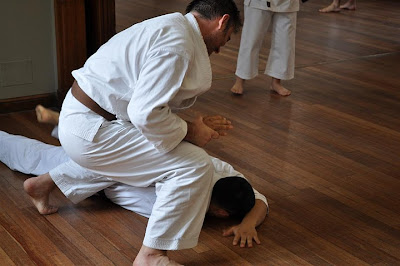
Second, you must feel it. If you can understand how the technique works from within your own body, then it becomes easy to manipulate your opponent's body. There are three main ways to gain this skill. One: to the extent it is possible, practice on yourself. Much can be learned by poking, prodding, twisting and manipulating your own joints and points. Two: when working with a partner, help your partner make the technique work better on you by literally telling him/her how to create more pain in you. Three: (and this is the most useful step) volunteer to be the uke for the senior teachers. (Uke is the person on whom the teacher demonstrates a technique. The term means "one who receives", and is properly pronounced "oo-kay" though Americans commonly pronounce it "oo-kee".)
Chris Martingilio and Mike Mellgren waste no time stepping up to volunteer as uke for whichever senior is instructing. By allowing the senior to demonstrate on them, they get to feel how a move is supposed to be applied, and they pick up subtleties that others miss. So, while many around are backing away, grateful that Chris and Mike are being subjected to the pain, they are wisely enjoying a level of learning that the others are unaware of (otherwise, there would be a line of people asking to be uke). Now, I do admit that as the old man and the senior, it's nice to not have to act as uke much any more. But, I am ever so grateful for the years I was on the receiving end of Sensei's techniques, and I applaud Chris's and Mike's choice to step up often.
Third, and last, you must actually do it. How can you know that a knockout is possible unless you have performed knockouts? How can you know what correct application feels like unless you do it. Kyusho-jitsu and tuité are not primarily theoretical (despite the time and energy which goes into learning and understanding the theory). They are practical, in the hands as much or more than in the head. In the end, this knowledge requires hands-on training, and lots of it. In the end, there is no substitute for practice. So, see it, feel it, do it.
Thanks for reading.
Now, go train!
CT
Sunday, June 5, 2011
Even Masters Have More to Learn


I have always been impressed by the eagerness of my sensei (George Dillman) to learn more and understand better. I saw the same quality in Professor Wally Jay. And, I hope I have something of that in me, as well. Maybe that is the quality which all masters must have to be masters. If so, I got to witness it in some senior Korean masters. You see, A few days of ago, I taught a group of very high ranking Taekwondo practitioners. At least one of them was from the Korean Tigers team (check them out on You Tube). And others were prominent competitors, coaches and teachers.
What was interesting for me was the eagerness of these masters to learn the techniques and principles of kyusho-jitsu and bunkai. For three hours, they peppered me with questions about their forms, and were delighted at what the movements represented. The experience showed me again how truly profound the teachings we (DKI/KJK) share are. And it showed me again how valuable our teachings are for those who have passed their competitive years. So, I guess the lesson is, keep studying, keep learning, keep working.
Thanks for reading,
Now, go train!
CT
Monday, May 30, 2011
Wally Jay, June 16, 1917 - May 29, 2011


I was at George Dillman’s Martial Arts Training Camp for a weekend training session. I knew before arriving – all of us knew – that Professor Wally Jay had been hospitalized for a stroke. I asked Sensei Dillman, “Is there any news on Wally?” (“Wally” – it says something about the man that one of the most respected teachers in the world was spoken of in such a familiar fashion.) “It doesn’t look good,” George replied. So, I was not surprised when I walked into his office Sunday morning to ask a question, only to find him sitting behind his desk with tears in his eyes. “Wally died,” he told me.
Since I am a clergyman, I led an impromptu funeral service at the camp, interrupting the training to announce the news. So many of the senior instructors present knew Wally, some very well. Those who didn’t know Wally himself, know Leon Jay, Wally’s son, and heir of Small Circle Jujitsu, so there was much emotion in the room. For those of you who were not present, I would like to share something of our service (as accurately as my memory permits).
Will Higginbotham, who was very close to Wally, was teaching. I walked up with a paper napkin in my hand, as he was saying to the group, “Ok, let’s get up and try that.” “No,” I said, handing Will the napkin (we knew he would be crying), “We have learned that Professor Wally Jay died during the early hours of this morning.” Stunned (but not surprised) silence fell on everyone. Then I read a few words from the apostle Paul: “The things that I have taught to you, teach to reliable individuals who will be able to teach it to others also.”
“We are the people Professor taught, it is our responsibility to teach others also. But, it is not just about his jujitsu. Wally Jay was a remarkable human being and we must teach those values as well. I would like to tell you the story of when I first met Wally. It was during a combined Wally Jay/George Dillman seminar. At one point, we were practicing one of sensei Dillman’s joint manipulation techniques. Unfamiliar with the particular movement being practiced, Professor Jay walked over to the nearest of Dillman’s students (who happened to be me) and said, ‘Show me how to do that.’ I was deeply impressed by the fact that there was no ego in the way of the Professor’s desire to learn something he didn’t already know, and how willing he was to learn from anyone.”
I then asked the senior teachers to share one story about Professor. Will Higginbotham spoke about a call he received from Professor. “He called me and said he wanted to come to my house for a couple of days before teaching a seminar. He arrived with his notebook in hand, and began asking me questions.” For two days, Wally pumped Higginbotham for information on pressure points – occasionally stopping to show Higginbotham same nuance or subtlety of Small Circle Jujitsu. “I was honored to be receiving such instruction from Professor. But, it was Professor Jay who took my hand and said, ‘Thank you for teaching me.’”
Ken Smith, one of Professor Remy Presas’ most senior students echoed the sentiment. “The first time I met Wally Jay was at a Wally Jay/Remy Presas seminar. We were training sinawali, and Wally picked up a pair of sticks. Remy said to me, ‘Ken, you go teach Wally.’ So, I went over to teach Wally Jay, shaking with fear. While we were practicing, Wally accidentally hit me in the hand, but that was ok. Then, a little later, I accidentally hit Wally Jay in the hand. I felt so bad, and was apologizing, but Wally just smiled, and said, ‘Don’t worry, soon we will be putting down the sticks, and then it will be my turn.’” Ken’s final words were, “Now Remy has a training partner with him in heaven.”
Kim Dillman Foreman remembered when Wally, Remy and George began to first do their big three seminars. “I would get up, and Remy and Wally would already be up, trading techniques and information. And because I was up first, I got to be the designated uke. Wally was such a kind and gracious man, he was like a father to so many of us.”
Matt Brown, another of Dillman’s senior students, spoke of a time (the last time) when Wally had been at the Dillman training camp. The topic of training had included work on “toate” (methods of affecting a person without physical contact). Students were working on moving each other by projecting energy. Matt said, “Wally comes up to me and says, ‘Matt, see if that works on me.’ So, I was trying to move Wally using my chi. ‘Is it working, Professor?’ I asked. ‘I can’t tell,’ Wally responded. ‘I’m 85 years old, I always sway back and forth.’”
Then it came George Dillman's turn to speak. At first sensei couldn’t say anything, but only covered his face with his hands. Then, with tear streaked cheeks and a smile of happy memories he told us, “If you knew Wally and Bernice, you knew they always over-packed for a trip. So a couple of younger guys had been helping carry these large bags of luggage to the hotel room. Wally had unzipped a bag part way and was starting to unpack, when they asked him his secret to living so long and with such vitality. ‘First, you must live a healthy life,’ he told them. ‘Don’t smoke and don’t drink.’ But Wally’s bag was so heavy it was unzipping itself, and as he was telling them about healthy living, out fell a big bag of Snickers bars. I laughed at him, and he looked at me and said, ‘You gotta have at least one vice.’ After that, I called some of my students, and told them that they should bring Wally bags of Snickers Bars when they picked him up at the airport. So then Wally called me and said, ‘You told them!’
“And another time, we were were teaching a seminar together in Minnesota. Wally had this one guy in a leg lock. His other leg was on the floor, and I said, ‘I think you can knock him out!’ ‘How?’ said Wally. I told him to stomp the leg on the floor, hitting along the spleen meridian. ‘But what if he get’s hurt?’ Wally asked. ‘That’s ok.’ I said, ‘I’ll tell ‘em that you did it.’”
That story made me smile, because I was the guy Wally had in a leg lock.
I finished our impromptu service by reminding everyone of the scripture that tells us, “There is a time to be born and a time to die.” I followed with a prayer, entrusting Wally’s soul to the mercy of our Creator, expressing our faith that our lives continue in God’s love, and asking for God’s comfort upon Wally’s family and all who mourn his passing. Then I reminded everyone again that it was our responsibility to preserve and pass on Professor’s teachings and example. And, with the final Amen, I said, “We need to honor Wally Jay, now, by practicing finger locks.” And so, we returned to our training, focusing on the small circle concepts that had become so central to our practice of pressure point methods and joint manipulation. And we all, like sensei Dillman, smiled with tear-filled eyes as we celebrated Wally Jay in his teachings.
Wednesday, May 18, 2011
Grading Post mortem.

After a week or so I can now take stock of the grading and think about what went well and what didn't and how the preparation helped...or not?
My main concern leading up to the day wasmemory recall of the techniques. I've grained long enough to know them to a fair standard (some better than others, granted) so this didn't trouble me so much. I did however *still* get muddled up with the Japanese names and find that there is lag between being asked for a technique and my brain processing it and outputting it as action. So what to do? Well as MattKlein commented, just swot up on techniques and have someone call waza at random. Over and over again. And over some more. This worked quite well and in the grading I was confident that I could manage.
The second issue was not knowing who I would gradewith. As shorinji kempo is based on pair work this can have an effect on performance. Naturally techniques should be able to applied to anyone but in a grading it comforts you to know who your partner is. As it happens when I met mine and we had a chance to go through embu I felt a lot easier. He knew his stuff and was fluid in movement. No problem.
In fact during feedback Mizuno sensei made this very point about grazings. To him a grading is useful as it pressure tests technique. Yes they make allowances for the fact that sometimes we don't have a chance to practice with a partner beforehand but in real self defence you have to make the technique work. And this is grading: making it work under pressure. It's no good asking an adversary on the street to stop and start again "cos I wasn't prepared".

Lastly it's worth mentioning sweat. I know it's notpleasant but on a hot spring day in a packed dojo it becomes an issue when you're trying to apply wrist locks. The answer? Think creatively. Go with the flow of the technique and focus on the outcome (immobilising an opponent, trapping an opponent or maybe throwing). It was trickier but a valuable lesson.
Monday, May 16, 2011
Grading Day
Black belt grading came and went (it was the 7th May 2011) and I was lucky enough to meet and take the exam with a very capable kenshi. All went well apart from a few brain jams plus putting locks and wrist restraints on sweaty people on a hot day tends to be….challenging.


Beautiful day with view of the Royal Albert Hall and a post grading chinwag and beer with Toby.
Smashing.
Tuesday, May 3, 2011
Sai-jitsu

A while ago, when I taught a sai-jitsu seminar, I learned that one attendee would be a teacher from one of those American-Karate-Black-Belt-Schools-of-Excellence-of-America schools. I figured the poor guy would be completely and hopelessly lost when exposed to genuine classical sai usage (as opposed to competition flash). So, I was watching for him to arrive, and he did. But, then I noticed his sai, not holographic toys, but actually decent Shureido® brand.
I went up to talk with him, and he told me that he had wanted to supplement his contemporary American Competition Karate Style with something traditional. So, he began to study a solid and very legitimate kobudo system. I figured he would be right at home during the training. Well, that was almost true.
During the seminar, I taught methods of the sai which are in accordance to the nature and shape of the weapon. However, these methods differ considerably from what is typically taught. So, my traditionally trained guest was stunned and dismayed to be performing the exact movement he was taught, but to devastating effect, (finding that even the subtle aspects of the movement were integral to the technique).
What is significant is that classical sai methods are very obvious (once you have been shown them, it is like, "Duh!") and kind of easy to perform (the weapon does the work). My experience is that, once a person learns the classical use of a weapon – any weapon, really – it becomes incredibly easy to understand how most weapons are to be used. And reading the kata becomes pretty easy. However, classical weapons use is not cool, not flashy, and not nice – just real.

I'll be teaching classical methods for bo and sai in Romeoville, IL, on May 14. Join me if you can (brown & black belts only for the sai-jitsu training). Until then, thanks for reading.
Now, go train.
CT
Subscribe to:
Posts (Atom)