Showing posts with label book. Show all posts

Friday, December 11, 2009

Book review: The Way of the Warrior


This is a hardback, colourful almanac of descriptions of the world's martial arts but is it any good?

There are many entries in the book, which is encyclopaedic in its format, and it does give a good, broad look at the martial arts around the world. I'm sure that some esoteric arts might not be covered but to me it looks pretty comprehensive. The entries I have knowledge about seem fairly accurate but don't stray from the 'party line' and therefore have no analysis. This isn't surprising from such a broad look at the martial arts. What does lift this book is the photo documentaries sprinkled throughout which give more insight into the human aspect of living martial arts, examining how people today, all around the world, dedicate themselves to their art. As a human documentary this is interesting and helps to convey the idea that to some people the martial arts is a unifying force, despite its basic premise of conflict.

Chris Crudelli is mentioned on the cover as the author but apart from a couple of little editorial snippets where he adds that he has trained in this style or that, I can't see what else he really adds. Perhaps he was responsible for the photo journals.

Buy it or not? Good clean, fun book, lots of descriptions about many martial arts around the world but no in depth analysis or critical appraisal. Have this on your shelf as an encyclopaedia of martial arts (especially as Borders is now closing down and has some pretty good offers on!), or just use Wikipedia for free.


Saturday, October 17, 2009

New books

Found a book on fencing in the library and bought another on Medieval Combat.

Unfortunately the fencing book I borrowed 'blind' as I ordered it from another library over the web so didn't see the contents beforehand. This meant I was a little disappointed as what I really needed was a broad overview of the basic foot movements, stances and positions. This is undoubtedly a detailed book but this is for the advanced fencer. I have gleaned some interesting information: prime, seconde, tierce, quarte, quinte, sixte, septime, octave... but on the whole too advanced for me. (Fencing: Essential Skills Training by Ed Rogers)

Medieval Combat by Hans Talhoffer (ed Mark Rector) seems more my thing. I won't be taking any lessons from this into the salle or the dojang (particularly the illustration of trial by ordeal of a man in hole pitted against a woman with a club...!) but it's given me more to get my teeth into.

This book is a reproduction of Hans Talhoffer's fifteenth century treatise on combat and fencing called 'Fechtbuch'. Smashing illustrations showing combat covering wrestling, sword work, pikes, daggers as well as mounted conflict. Very interesting to see the parries, stances and weapon positions used plus plenty of blood with hewing of heads and murder strokes as well as weird 'judicial duels' where the loser would fight in front of his own coffin.

Great insight into medieval justice, fighting techniques and attitudes towards weapons.


Friday, September 4, 2009

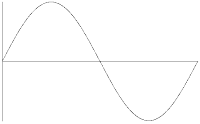
Sine wave in forms/hyung/poomse

I'm currently reading a fascinating book by Alex Gillis regarding the history of Tae Kwon Do which is called 'A Killing Art-The untold history of Tae Kwon Do'. This is an excellent read, if somewhat dry in parts, and reveals some interesting facts about this very modern art.

I often thought that certain Korean Tae Kwon Do practitioners had a certain bobbing up and down feel to their forms somewhat and reckoned this was due to stylistic or cultural differences. I've always been told to move through from one technique to another aspiring to keep the head as level as possible and to minimise 'bobbing'. Gillis says that General Choi introduced what he called a 'sine wave' to his forms when he was introducing Tae Kwon Do to North Korea in 1980. This, maintains Gillis, "distinguished it from Karate and Kim Un-yong's Tae Kwon Do".

This sine wave relies therefore on gravity for power and not a hip rotation and as Gillis writes, "gave Choi's...patterns a distinct style-slower, more rhythmic".

Whether or not this is more powerful I cannot say as I have never practiced the sine wave but it helped concretise the schism within Tae Kwon do and meant Choi could claim the North Koreans were practicing "pure Tae Kwon Do" and that other instructors were "fakes".

Here's an interesting video showing the diminuative Choi himself emphasising the 'big' sine wave:


width="425" height="344">


And this other video shows 'Choong Moo' hyung being performed showing this chracteristic bobbing motion:


Thursday, June 4, 2009

Four Shades of Black

I'm reading it now and LOVING it! It's beautifully laid out and makes a lot of sense, written by a guy with plenty of experience.

Just check out the typography:

(Cwooooar!)

The photos are wonderful, powerful pieces on black backgrounds which enhance the body movement. I have some design issues with it such as certain photos are laid in the centre of the full spread and as such are lost when the book has been bound. This is probably because the gutter width is too tight (10mm I think) so I have to bend it out uncomfortably to read the text. Having said that, it's generally well designed and a nice book to look at (which is not the case for a lot of books on the martial arts).

Never mind though because Mulholland writes well about the kata applications, history and deeper techniques of Goju ryu. For all Okinawan practitioners it's a must but traditional karateka will certainly get off on this too (I am!).

Interestingly Mulholland puts forward the idea that karate 'lost' some of it's grappling elements at a time when it was carving out a niche in Japan where Ju jitsu and aikido had already taken this ground. In fact Mulholland bemoans the fact that many karateka no longer practice bunkai and he gives this much attention in the book-no wonder then that the foreword is by Iain Abernethy (a leading exponent of karate application). 

Fantastic.

And as a bonus I found it from my local library!


Saturday, December 20, 2008

Autumn Lightning - The Education of an American Samurai by Dave Lowry. A Book Review.

Autumn lightning details not only Dave Lowry's apprenticeship and learning process with the Japanese sword but also the lineage of the style he practices: Yagyu Shinkage ryu weaving the two themes together with relevant insights and inner thought processes. This book is compelling as it is a personal journey which reflects the ancient philosophies and practices upon which this particular ryu was founded giving two aspects to this bugeisha's lifelong journey.

Don't be misled into thinking this is simply a narrative of Lowry's day to day training nor a dry recounting of the ryu's inception and subsequent history! Lowry also works in a lot of feeling about traditional martial arts and underlying philosophies which for me, as a martial artist, help make sense of some of the more esoteric aspects of budo. Easily readable this book covers some interesting concepts such as the spiritual side of training, the hard physical obligation of training, mushin, musogi and much more. 159 pages long in my version and with a good writing style I reckon there's no reason not to make this part of your martial arts reference library.