Thursday, September 10, 2009

What on earth is that technique?

I'll start with an easy one:
What on earth is the technique you’re trying to do in that picture? If it’s ude-giri your hand is too high up his arm (pressing down on his shoulder or the upper part of his arm isn’t going to do much), for waki-gatame you’re standing too upright and it can’t be just kote-mawashi since it’s impossible to put enough pressure on the wrist in that position. Besides that kiba-dachi, while traditional, is not a great stance for that position since he can just plant his knee into yours and you’ll collapse, losing the hold. -- Zara
This is reference to a now retired side-bar image, actually taken from a past post and reproduced below:
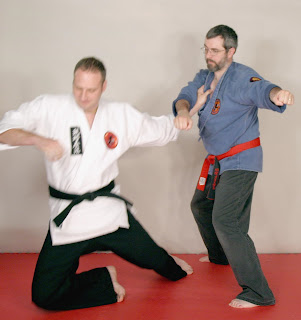
In Jiu-Jitsu formal stances are typically used transitionally, and are learned in the context of actual application. For example, in this photo I am applying a reverse-armbar -- a restraint and control technique -- from a horse-riding stance:


A reverse armbar

From here I could take Adam down to the ground or move into a more mobile lock to better escort him to the local police station. Either way I would not need to stay in this position for very long.
Of the techniques listed, I'd say it's closest to waki-gatame:


Standing waki-gatame

Think of it as a variation.

The neat thing about the reverse-armbar is that there are lots of ways to make it work. You can lock the shoulder, elbow, and wrist. If you have difficulty with one joint -- typically resistance or flexibility -- you can switch emphasis to another.

In this case Adam has a fairly flexible elbow -- note the hyper-extension -- so I'm using the wrist and using my ulna bone to painfully slice into his upper arm (an alternative to torquing the shoulder - probably more jiu-jitsu than judo!).

As to the risk of his planting his knee: I don't think so! Sure it's a posed shot, but given that I've got the lock and his balance, as he moves I either inflict more pain, stopping the movement, or flow with it into something else.

Dealing with conflict

Wow! My initial reply and last post seem to have rubbed my semi-anonymous commenter, Zara, up the wrong way. See his extensive comments following my initial response and follow-up post to this older article. A sample:
Granted, blogs aren’t the best source of information in the first place (usually the content is rather mundane, one-sided and superficial) but to be told to buzz off and ‘do your homework’ is a first. So much for common courtesy and cooperation in spreading martial-knowledge. A simple refusal would have been enough, I don’t need your condescending attitude, nor your useless advice. -- Zara
While somewhat miffed, I'm a bit surprised that I haven't run into this kind of conflict as a blogger previously. I am somewhat averse to public forums because I've got sucked into flamewars in the dim and distant past, where relative anonymity, plus lack of verbal and visual cues often leads to a downward spiral into insults and baiting.

In this case, however, I clearly lit the match, albeit inadvertently.

Let me explain my side:

Zara's initial post asking for some advice on a specific problem was sincere, and definitely not trolling, but I was hesitant to give a detailed reply because I am reluctant to even try to teach techniques over the internet. I don't know anything about Zara besides what he has written in his initial comment, and -- unfortunately -- because there was no way to contact him directly I either had to respond publicly or ignore him.

So I posted a somewhat curt reply and a low-level follow-up post with the kind of general advice that I normally give on this blog: Ideas that will help people with a clue already, but not specific instruction.

I hoped that he might get a bit out of it, and respond with a more specific enquiry, providing details of what he had tried and where he was getting stuck, etc. I probably should have given less advice and invited him to email then and there, but there you go.

Then I went off to attend to my daily chores, and that evening played around in my jiu-jitsu class a bit with one of the scenarios that Zara described, using it as a theme for part of the class, and tested out what to do in a tricky situation. I'll write more on that in a later post.

Late that night I read Zara's responses and thought: Whoops! You can read my comments at the end inviting him to email me, and pointing him to one more post.

Conclusion: From my perspective, I was pleased to get the interest, but cautious about how I responded. With hindsight, I should have taken more time responding, and asked Zara to be patient, and started off with an offer to take the conversation to email straight-away.

So, on reflection, I want to thank Zara for:
  • Asking good questions, which will stimulate some more blog posts (once I figure out how to respond more usefully, without breaching my self-imposed boundaries)
  • Prompting me to reflect once again on the nature of conflict, and to work on my tone and clarity when responding to comments from the privileged position of blog-proprietor
My offer stands to get in touch with me by email: tenchi.ryu.jiujitsu@gmail.com.

By the way, a brilliant book about applying martial arts concepts to conflict resolution is Terry Dobson's Aikido in Everyday Life: Giving in to get your way. Clearly I still have a lot to learn.


[Edited following Zara's reply to refer to Zara as a he, not a she.]

Tuesday, September 8, 2009

Arresting techniques

Zara left a detailed comment on one of my articles from 2008 -- Some notes on come-along techniques -- raising some interesting points.
Very interesting article, come-alongs or taiho-waza (arresting-techniques) are fascinating to study but often an area that is poorly understood and consequently just glanced over. Probably because it's inherently dangerous to attempt to control a standing, struggling opponent (always risky in terms of escape and counterattack) and very technical in nature. -- Zara
Thank-you. Like most sophisticated areas in martial arts these techniques need expert instruction and significant, regular practice to achieve competence; and more instruction and practice to make 'em really good.
If techniques and body-mechanics aren't perfectly understood and executed the adequate pain-level will not always be maintained: either you'll injure him or he'll just slip out and since most people don't take kindly to such treatment you'll be in for one hell of a fight.
There's certainly a need for sensitivity in training these techniques and that comes with cooperative practice over a long period. You need to be able to feel that the lock is on, and practicing very slowly is both safe for training and a good way to acquire the necessary sensitivity.

I once trained with some Olympic judoka who were all very strong and had effective if muscular throws, but their locks were not good at all. They were used to competitive practice, and seemed afraid of having their arms snapped; not trust, and probably with good reason! Consequently they had no feel for locking.

Uke's balance must also be broken. Along with pain compliance this reduces the strength that can be brought into play to resist the technique. For example, I have some very flexible students who I just can't make certain locks work on, but in attempting to apply the techniqueI invariably break their balance to a huge extent. In a self-defence situation you need to be able to feel that a lock isn't working and aim to make a clean transition into a different lock or throw. This ability requires lots of practice to acquire!

The issue of making these locks work in a self-defence situation is interesting. In the system I do we teach model entries, plus effective transitions out of escapes from standard attacks (usually grabs, chokes, or other holds) into locks and throws. These also need to be practiced until they become second nature.
I'm training for my first dan in ju-jutsu, part of the requirements are two come-alongs while uke is standing, two when he's lying flat on his belly and two on his back (forcing him to stand up). I do think I have some notion of which techniques would be suitable for these tasks but I would appreciate it if you would write a follow-up post to this one delving a bit deeper and going over some appropriate techniques (preferably with photo's).
Interesting requirements. Rather than do your homework for you ;-), I suggest that you take the locks you have in mind and carefully experiment with them with a fellow senior student. Managing the movement from floor to standing while safely maintaining control is the name of the game. Telling your uke what to do is also helpful, "Roll onto your side! Get-up!", but you must allow them, even help them to do so.

Please let us know how you get on with your explorations, and what you learn. Your own instructor(s) should be your first and best source for detailed, hands-on guidance.

Good luck!

Monday, September 7, 2009

It Helps to Not Give a Sh*t


Back in 1997, DKI member and physician Chaz Terry helped set up a small investigatory study of pressure point techniques which was conducted at University of Pennsylvania Hospital in Philadelphia. My account was published in Black Belt Magazine (click here to read the article) and as a chapter of Humane Pressure Point Self-Defense. I was present for the sole purpose of recording and writing about the event. So, I did not participate directly in the process. But, I had the best seat in the house.


The room was cold, lit with fluorescents and generally "institutional". Each subject to be knocked out was wired up with electrodes to monitor such things as brain waves, heart rhythms, blood pressure, and so on. This took 20 minutes. Then the subject would stand on a wrestling mat (a safety precaution) while "pre-strike" data was gathered. Cameras were synced to medical monitoring devices and time was spent waiting for everything to be ready. Then, the person who was performing the strike was told to proceed, but, oh, not too forcefully because we don't want to dislodge any wires, and be careful not to cause too much movement because that creates artifact, now go ahead and knock him out.


This was an incredibly stressful setting in which to do anything. Those doing the striking were out of their element, anxious, being asked to think about more than just the technique itself. Not surprisingly, many had some difficulty with their techniques. When this would happen, when the simple craziness of the setting got in the way, and someone would fail in performing an effective knock out, George Dillman would say, "Ed, you do it."


"Ed" is my colleague Ed Lake. And Ed would do it. He would walk up and "bam" the subject would hit the ground.


At one point, Dillman-sensei was speaking to one of those struggling to get the knock out to work. "Do it like Ed!" He said. "But, Ed doesn't give a sh*t!" came the reply.


This is an important observation. When striking a pressure point, it can be our own anxieties and concerns which keep the technique from working. We hinder our energy from flowing. We worry that we won't be able to succeed, so we don't. We worry that our uke (the person who receives our knock out technique) will be injured, so we fail. We strike too hard, or not hard enough, while holding back our intent, our energy, because of all our concerns, all our fears, all our issues of ego and morality, all of our thoughts about "what if it doesn't work" and "what if it does."


It helps to "not give a sh*t." It helps to have clarity of intent – action without concern for all of the possible, undesired outcomes. Such an attitude increases the possibility of success because there is nothing to hold one back from success.


Of course, my problem is that I do "give a sh*t." All sorts of concerns, fears, worries, etc., plague my thoughts, and clamor for my attention. And I become, worried, fearful, anxious, ego-invested and the like. I become weighed down with the detritus of my own emotional baggage, and divide from singularity of purpose by a cacophony of mental chattering.


Of course, it is easy to say, "Do it like Ed!" It is easy to tell myself that I shouldn't be distracted by inner conflict, shouldn't be bogged down with useless concerns, shouldn't give a sh*t. Yeah, easy to tell myself, but it doesn't make a bit of difference. All the useless stuff is still there. Instead, I have to make it irrelevant. So, I have taken tactical approach.


Anyone who trains with me will often hear me talk about redundancy. The idea of redundancy is this, "If you screw up your technique, it should still work pretty good." This is why I seem to put pressure points at the end of the line. I believe the pressure points are incredibly important – I want to guarantee that things will always work.


Imagine it like this: Someone grabs me and I begin my defense. In that slow motion of crisis, the thought goes through my mind, "Gee, I hope this works." Suddenly, I am invested in a particular outcome and I give a sh*t. "What if a miss the pressure point? What if I don't hit with enough energy? What if I hit too hard? What i he is resistant on that point and I should have aimed for another?" Suddenly, in that moment, the fear and anxiety hit. My chi and my anal sphincter pucker and withdraw – and I have defeated myself. But, if my technique is sound, if it is redundant, certain to work well even if I screw it up, then I think, "Doesn't matter, even if I miss the point, or it doesn't work right, I still get to hit him, and I still have the advantageous position, and I still have superior control, so it will be fine." And suddenly, I don't give a sh*t anymore, because I have created the circumstances under which I am guaranteed a satisfying outcome. The result? I relax and my chi flows, and my technique works great.


If you want to read more about redundancy, you can read another article of mine in Black Betl (click here).


Now, go train.


Chris Thomas

Friday, September 4, 2009

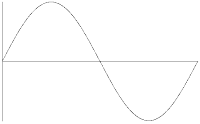
Sine wave in forms/hyung/poomse

I'm currently reading a fascinating book by Alex Gillis regarding the history of Tae Kwon Do which is called 'A Killing Art-The untold history of Tae Kwon Do'. This is an excellent read, if somewhat dry in parts, and reveals some interesting facts about this very modern art.

I often thought that certain Korean Tae Kwon Do practitioners had a certain bobbing up and down feel to their forms somewhat and reckoned this was due to stylistic or cultural differences. I've always been told to move through from one technique to another aspiring to keep the head as level as possible and to minimise 'bobbing'. Gillis says that General Choi introduced what he called a 'sine wave' to his forms when he was introducing Tae Kwon Do to North Korea in 1980. This, maintains Gillis, "distinguished it from Karate and Kim Un-yong's Tae Kwon Do".

This sine wave relies therefore on gravity for power and not a hip rotation and as Gillis writes, "gave Choi's...patterns a distinct style-slower, more rhythmic".

Whether or not this is more powerful I cannot say as I have never practiced the sine wave but it helped concretise the schism within Tae Kwon do and meant Choi could claim the North Koreans were practicing "pure Tae Kwon Do" and that other instructors were "fakes".

Here's an interesting video showing the diminuative Choi himself emphasising the 'big' sine wave:


width="425" height="344">


And this other video shows 'Choong Moo' hyung being performed showing this chracteristic bobbing motion:


Wednesday, September 2, 2009

Encouragement for beginners to sparring


I offered some pre-tournament sparring practice to a friend who gladly accepted. Off we went to the country park...

As we searched for a suitable clearing to kick off our shoes I asked her what her 'problem' was (so I could focus on this in the following 45 minutes) and she replied that she found it difficult to score a point. She was a bit flustered by the plethora of techniques she knows and felt unable to bring them into play during sparring.

OK-let's bring up her confidence by concentrating on a few essential sparring techniques, after all much free-fighting is made up of front kick, round kick and a variety of straight punches. Of course we aspire to be able to use all our techniques in order to score the point but invariably we rely on a stock of well serving base techniques and sometimes the simpler, the better.

So with a minimum of time we set about improving her confidence (she'd only sparred twice in class before!) and this is how we did it:

Round 1: Just front kicks from her. I would encourage her to connect with the attack and I would counter at competition speed with anything I fancied but she must use only front kick.

Round 2: Same deal for me, but front and round kick for her.

Round 3: Front kick, round kick and punches.

Last round: Focus on these three but feed in any 'fancier' technique if she felt that there was a scoring opportunity availing itself. (In the end she only really added in back kick and possibly side kick).

I also emphasized kihaping.

How did it go? She's a natural. She didn't need my help she just needed confidence. It's easy to forget that when we started out in a particular style there is a bewildering amount of techniques that we are exposed to directly in our syllabus or indirectly in group classes and often this is just too much information and we cloud up. "Oh yeah but I can do this, no wait....Er, what about this technique...."

No. Stop. The object of competition sparring is to get the point. To score within whichever framework of rules exist. In order to score you have to react to the attacks of the opponent as well as look for opportunity to counter or initiate. My advice today was to use a core set of techniques (as the student is a relative beginner) in order to score points. Keep it fairly simple.

What I didn't do was go easy on her. My attacks were speedy and of varying heights: I wanted to get her flinching, checking out her blocking reactions, which were great!


Photos courtesy of my little girl...

The dojo, its purpose and meaning

I came across this wonderful evocation of the nature of the dojo -- our place of training -- in aikidoka Richard Strozzi-Heckler's book Holding the Center - Sanctuary in a Time of Confusion:
A dojo is a space of commitment in which people practice together. What is powerful about the dojo is what it tells us of learning, and ultimately, of waking up, of being alive.
In Japanese, "dojo" refers to the place where we train "in the way". This points to two important distinctions. The first is that the dojo is a place of learning where one practices what is being taught. This is different from the conventional classroom where students sit passively taking notes or listening to a lecture. This is not to say authentic enquiry is unavailable in lecture halls, but it points to the difference between academic knowledge and an embodied knowledge that allows people to take actions that sustain and enhance their lives. In a place of learning like the dojo students practice what is being taught and over time begin to embody the subject matter. It lives in the body, it is who they are.
The second distinction revolves around the concept of "Do", which translates as "Way". The origin of the word "dojo" comes from the Sanskrit bodhimanda, which means the place of awakening. The Japanese kanji for Do is composed of two parts. One depicts a man walking on a road. The other is the human throat, which surrounds the jugular vein, representing the very core and pulse of our life. A man walking toward life. The Way is a theme of life. The dojo is a place where we awaken our body, grow the self, and unite with the spirit through rigorous and compassionate life-enquiry.
Walking back towards the dojo I can see students bowing at the entrance of the dojo as they arrive for the evening's training. Bowing is a ritual in aikido, as it is in many martial arts. At the beginning of the class we bow in respect, and at the end of the class we bow in respect. It's also a way of acknowledging the place where we learn. I have a Buddhist friend who bows to any place where he feels learning and training have taken place. This has included hotel rooms, a grove of trees, delicatessens, park benches, a friend's living room, even a jail cell where he was once detained for an illegal protest.
My teacher once tapped me on the chest and said "Jiri shin kore dojo". Mind as it is, is the place of training. He was reminding me that the dojo ultimately lives inside us, in our hearts, speech, thoughts, and actions. The dojo exists because of the meaning we give it. This meaning can never be lost from its place in the world because it is that place. The dojo is where we declare it to be. Each moment can be a place of awakening, of learning, of walking toward life.
Whew! That bears reading and re-reading.

A dojo is a place where we train

Not only can we develop ourselves and our relationships with others, but we can also develop our relationship with a space. No matter what difficulties I am facing in the outside world I invariably feel better when I arrive -- or even in anticipation of arriving -- at a dojo that I know.

This same spirit that we invest in our dojos, we should labour to bring to our homes, our work-places, and our schools.